
Atemu
Interested in Linux, FOSS, data storage systems, unfucking our society and a bit of gaming.
I help maintain Nixpkgs.
https://github.com/Atemu
https://reddit.com/u/Atemu12 (Probably won’t be active much anymore.)
- 48 Posts
- 892 Comments


The usual; check the server and client logs.



 16·2 months ago
Mastodon’s UI for groups is terrible. This community is indistinguishable from an account named “@Firefox” with thousands of followers unless you open its page and notice it says “Group” and understand what that means.
Your browser cannot block server-side abuse of your personal data. These consent forms are not about cookies; they’re about fooling users into consenting to abuse of their personal data. Cookies are just one of many many technological measures required to carry out said human rights abuse.

I’d look further into that bug because it’s not happening on my end.

Do you have a better source than a 5 y/o comment in an issue?
Hier wurde einfach nicht ordentlich recherchiert, es wird LibreOffice verwendet. Es ist die gebrandete Version von Collabora, die einer der Haupt-Contributors von LO sind.

Freetube won’t have anything to do with h265 as youtube does not serve that format in any way.
 17·2 months ago
Drive is under a different org:
TS is a lot easier to set up than WG and does not require a publicly accessible IP address nor any public whatsoever. It’s not really comparable to setting WG up yourself; especially w.r.t. security.

As it says on the website, this is still in development and not actually ready for use by mere mortals quite yet. It hopefully will be at some point though as that is its explicit goal.

It’s a central server (that you could actually self-host publicly if you wanted to) whose purpose it is to facilitate P2P connections between your devices.
If you were outside your home network and wanted to connect to your server from your laptop, both devices would be connected to the TS server independently. When attempting to send IP packets between the devices, the initiating device (i.e. your laptop) would establish a direct wireguard tunnel to the receiving device. This process is managed by the individual devices while the central TS service merely facilitates communication between the devices for the purpose of establishing this connection.
If you’re worried about that, I can recommend a service like Tailscale which does not require permanently open ports to the outside world, offering quite a bit more security than an exposed traditional VPN server.
Good luck packaging new stuff
Packaging is generally hard on any distro.
Compared to a traditional distro, the packaging difficulty distribution is quite skewed with Nix though as packages that follow common conventions are quite a lot easier to package due to the abstractions Nixpkgs has built for said conventions while some packages are near impossible to package due to the unique constraints Nix (rightfully) enforces.
good luck creating new options
Creating options is really simple actually. Had I known you could do that earlier, I would have done so when I was starting out.
Creating good options APIs is an art to be mastered but you don’t need to do that to get something going.
good luck cross-compiling
Have you ever tried cross-compiling on a traditional distro? Cross-compiling using Nixpkgs is quite easy in comparison.
actually good luck understanding how to configure existing packages
Yeah, no way to do so other than to read the source.
It’s usually quite understandable without knowing the exact details though; just look at the function arguments.
Also beats having no option to configure packages at all. Good luck slightly modifying an Arch package. It has no abstractions for this whatsoever; you have to copy and edit the source. Oh and you need to keep it up to date yourself too.
Gentoo-like standardised flags would be great and are being worked on.
good luck getting any kind of PR merged without the say-so of a chosen few
Hi, one of the “chosen few” here: That’s a security feature.
Not a particularly good one, mind you, but a security feature nonetheless.
There’s also now a merge bot now running in the wild allowing maintainers of packages to merge automatic updates on their maintained packages though which alleviates this a bit.
have fun understanding why some random package is being installed and/or compiled when you switch to a new configuration.
It can be mysterious sometimes but once you know the tools, you can directly introspect the dependency tree that is core to the concept of Nix and figure out exactly what’s happening.
I’m not aware of the existence of any such tools in traditional distros though. What do you do on i.e. Arch if your hourly shot of
-Syugoes off and fetches some package you’ve never seen before due to an update to some other package? Manually look at PKGBUILDs?
Steam is its own package manager and native games usually assume that an FHS-conformant is present. Neither of those mesh well with Nix notoriously has nothing comparable to an FHS and usually requires everything to be defined in its terms.
 11·2 months ago
The writer will need to tag things down, to minimal details, for the sake of languages that they don’t care about.
Sure and that’s likely a good bit of work.
However, you must consider the alternative which is translating the entire text to dozens of languages and doing the same for any update done to said text. I’d assume that to be even more work by at least one order of magnitude.
Many languages are quite similar to another. An article written in the hypothetical abstract language and tuned on an abstract level to produce good results in German would likely produce good results in Dutch too and likely wouldn’t need much tweaking for good results in e.g. English. This has the potential to save ton of work.
This issue affects languages as a whole, and sometimes in ways that you can’t arbitrate through a fixed writing style because they convey meaning.
The point of the abstract language would be to convey the meaning without requiring a language-specific writing style. The language-specific writing style to convey the specified meaning would be up to the language-specific “renderers”.
(For example: if you don’t encode the social gender into the 3rd person pronouns, English breaks.)
That’s up to the English “renderer” to do. If it decides to use a pronoun for e.g. a subject that identifies as male, it’d use “he”. All the abstract language’s “sentence” would contain is the concept of a male-identifying subject. (It probably shouldn’t even encode the fact that a pronoun is used as usage of pronouns instead of nouns is also language-specific. Though I guess it could be an optional tag.)
Often there’s no such thing as the “default”. The example with pig/pork is one of those cases - if whoever is writing the article doesn’t account for the fact that English uses two concepts (pig vs. pork) for what Spanish uses one (cerdo = puerco etc.), and assumes the default (“pig”), you’ll end with stuff like *“pig consumption has increased” (i.e. “pork consumption has decreased”). And the abstraction layer has no way to know if the human is talking about some living animal or its flesh.
No, that’d simply be a mistake in building the abstract sentence. The concept of a pig was used rather than the concept of edible meat made from pig which would have been the correct subject to use in this sentence.
Mistakes like this will happen and I’d even consider them likely to happen but the cool thing here is that “pig consumption has increased”, while obviously slightly wrong, would still be quite comprehensible. That’s an insane advantage considering that this would apply to any language for which a generic “renderer” was implemented.
It ends like that story about a map so large that it represents the terrain accurately being as big as the terrain, thus useless.
As I said in the top, you’ll end with a “map” that is as large as the “terrain”, thus useless. (Or: spending way more effort explicitly describing all concepts that it’s simply easier to translate it by hand.)
I don’t see how that would necessarily be the case. Most sentences on Wikipedia are of descriptive nature and follow rather simple structures; only complicated further for the purpose of aiding text flow. Let’s take the first sentence of the Wikipedia article on Lemmy:
Lemmy is a free and open-source software for running self-hosted social news aggregation and discussion forums.
This could be represented in a hypothetical abstract sentence like this:
(explanation
 (proper-noun "lemmy")
 (software-facilitating
  :kind FOSS
  :purpose (purposes
            (apply-property 'self-hosted '(news-aggregation-platform discussion-forum)))))
(IDK why I chose lisp to represent this but it felt surprisingly natural.)
What this says is that this sentence explains the concept of lemmy by equating it with the concept of a software which facilitates the combination of multiple purposes.
A language-specific “renderer” such as the English one would then take this abstract representation and turn it into an English sentence:
The concept of an explanation of a thing would then be turned into an explanation sentence. Explanation sentences depend on what it is that is being explained. In this case, the subject is specifically marked as a proper noun which is usually explained using a structure like “<explained thing> is <explanation>”. (An explanation for a different type of word could use a different structure.) Because it’s a proper noun and at the beginning of a sentence, “Lemmy” would be capitalised.
Next the explanation part which is declared as a concept of being software of the kind FOSS facilitating some purpose. The combined concept of an object and its purpose is represented as “<object> for the purpose of <purpose>” in English. The object is FOSS here and specifically a software facilitating some purpose, so the English “renderer” can expand this into “free and open-source software for the purpose of facilitating <purpose>”.
The purpose given is the purpose of having multiple purposes and this concept simply combines multiple purposes into one.
The purposes are two objects to which a property has been applied. In English, the concept of applying a property is represented as as “a <property as adjective> <object>”, so in this case “a self-hosted news-aggregation platform” and “a self-hosted online discussion forum”. These purposes are then combined using the standard English method of combining multiple objects which is listing them: “a self-hosted news-aggregation platform and a self-hosted online discussion forum”. Because both purposes have the same adjective applied, the English “renderer” would likely make the stylistic choice of implicitly applying it to both which is permitted in English: “a self-hosted news-aggregation platform and online discussion forum”.It would then be able to piece together this English sentence: “Lemmy is a free and open source software for the purposes of facilitating a self-hosted news-aggregation platform and online discussion forum.”.
You could be even more specific in the abstract sentence in order to get exactly the original sentence but this is also a perfectly valid sentence for explaining Lemmy in English. All just from declaring concepts in an abstract way and transforming that abstract representation into natural language text using static rules.
Right from the horse’s mouth ;)
https://mastodon.social/users/protonprivacy/statuses/112162248226735964
 2·2 months ago
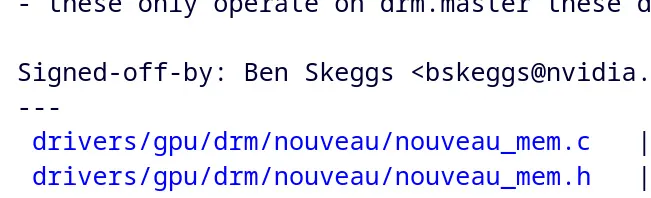
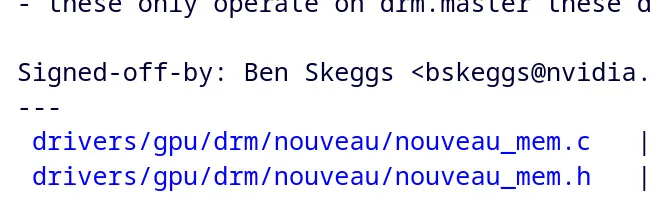
He had the last 6 months or so to work on it. He resigned from the Nouveau project and RH in September and likely joined Nvidia a little while later where he would have had plenty of time to work on this patch series.
more and more customary that (for some reason) they want your photo
Gotta keep the people with different skin colour out









What? If anything, it’d be more drain relatively speaking.
4W is quite a lot if you consider that a decently efficient laptop should draw 5-8W at idle max.