
If this was presented as an immune-boosting beer, and not a vaccine, way more right wing morons would be likely to take it. I’m pretty sure 3/4 of the antivaxxer right wing, are just men who are afraid to admit that they are afraid of needles.
As someone who has known a few anti-vax right-wingers, yes. 100% yes.
It’s almost entirely a fear of being poked with a needle, but they have to do very complicated dances to justify that fear, because they know if they admitted it, even to themselves, that such a immature fear would seem childish and weak, which is even more terrifying than the needle.
Humans never stop being children. We just develop more layers of complexity around that child, but the child still drives us.
and by sticking to their bullshit, they prove that they are way more weakminded than they would ever appear by just admitting.
They’re afraid of anything they don’t understand. Which is a fucking lot.
“The bureaucracy is inhibiting the science, and that’s unacceptable to me,” he says. “One week of people dying from not knowing about this is not trivial.”
Yeah, let’s not wait for proper testing and research. That’s a typical sign that something is very wrong.
It’s the Stockton rush playbook.
“Big science wants to hold me back because I’m an INNOVATOR and definitely not because there are real and present safety concerns.”
So we have vaccines that work and are tested.
And he’s trying to sell something that is untested, but an alcoholic beverage, which is known to be bad for health.
Yeah, I’m sure this is not just about money and he actually cares about people’s health.
There’s a lot of questions to be answered here but I feel like this could potentially be a pretty cool thing
He’s created a strain of yeast that seems like it could function as an oral vaccine
You could just filter off the beer and eat the yeast, or maybe put it into pills or something, or purify it into a normal injectable vaccine
But there’s a lot of people out there who are skeptical of pills and afraid of needles, or who just won’t want to eat powdered yeast
But a lot of those same people will happily drink a beer.
It could also be a way towards sort of decentralizing vaccine production. Imagine he starts selling little packets of dry vaccine yeast for people to brew beer with. Yeast is pretty forgiving in its storage requirements, keep it in its little sealed envelope and keep it reasonably dry, and it should be good for a couple years. You can ship that around the world without much fuss.
And people all over the world know how to brew beer. Get that packet of yeast into the local hooch-maker’s hands anywhere in the world, and they can turn it into a bunch of 1-pint vaccine doses in a week or two. No particularly special equipment or distribution networks needed, and vaccine distribution becomes as easy as hosting a kegger.
And if they’re able to reclaim some of that yeast to brew another batch, you’ve potentially even set them up for long-term vaccine beer production.
You might also be better able to convince people who might otherwise be skeptical about taking a traditional vaccine to just drink a beer. It’s not something scary like a needle, or weird and unnatural like a pill, it’s “just” a beer.
And you can focus your efforts a bit more on who you need to convince about the safety and efficacy of vaccines. You don’t need to convince a whole village to trust vaccines, you just need to convince the local brewer that the people already trust, and then you can piggyback off that existing trust.
Hell, I’m pro vaccine, but I know I’d probably be a little more proactive about getting mine if it meant I got to go have a couple beers.
Again, there’s a lot of questions that need to be answered, not the least of which are the basic safety and effectiveness of this
There’s also informed consent, making sure that the people drinking the beer understand that the beer is a bit more than just a beer, and the risks of alcohol (although if this is an effective delivery system, I think it’s likely that those risks are well-outweighed by the benefits of vaccines)
I definitely think it’s something worth exploring.
Yeah, getting yeast to manufacture vaccines would go a long way to making them accessible. Especially if successive generations also produce the vaccine. Probably lots of testing left to do and definitely better watch out in case it disrupts vaccine makers profits. I really hate corporate feudalism
The difficulty I see here is that it took the yeast not very long to mutate a beneficial effect, but it could just as quickly mutate away from that and even mutate something harmful.
The biggest cost factor for classical pharma is QA. Both in the form of certifications before release and in the form of regular QA during production.
So skipping QA can of course bring the cost down massively, but with the cost of making a potentially very dangerous product.
The difficulty I see here is that it took the yeast not very long to mutate a beneficial effect, but it could just as quickly mutate away from that and even mutate something harmful.
That seems unlikely. The entire way it works is the yeast produces proteins that “look” like a virus to the immune system, causing a immune response. However that’s the only part of of the virus in the yeast, there’s nothing else that completes the virus. It’s like… a steering wheel without a car, no matter how hard I mime swerving to run over a pedestrian nothing’s gonna happen, because there is no car.
If the viral protein mutated it’d either A) still be recognized as a viral protein and generate immunity for a virus that doesn’t exist, or B) generate a non-functional protein that the body would simply digest.
The version A) is a big issue actually, thanks to the Hoskins effect.
That means that if the immune system is trained for a slightly wrong type of pathogen, it might have a worse immune response to the actual pathogen at hand than if it wasn’t trained at all.
So if that viral protein would mutate a bit, so that it’s still recognized as viral protein by the immune system, it might cause the immune response to the actual virus to be worse instead of improving it.
It’s possible I missed it, but I didn’t see where it said how they came up with this strain of yeast. I was kind of assuming they used CRISPR or some other kind of gene editing to make it.
Regardless of if it was edited or selective breeding and random mutation, I do share those same concerns about how fast it might mutate and lose its effectiveness.
As far as it mutating into something harmful, sure it’s a possibility, but the same possibility technically exists with any strain of yeast out there in the world, untold millions of generations of yeast have lived, mutated, reproduced, and died in breweries, bakeries, and vineyards since humans first started brewing beer and baking bread, and it hasn’t gone horribly wrong yet. It’s certainly worth being cautious about, and I’m certainly no geneticist to make an educated statement about it, but I suspect it’s probably a pretty low likelihood.
The reason why I thought about harmful mutations in this context is because this strain of yeast has some kind of property that activates the immune system, otherwise the whole concept wouldn’t work.
That’s not something regular yeast does, so for regular yeast to evolve something like that, that’s a major step in evolution that doesn’t happen quickly.
But modifying the immune system activating payload is much less difficult.
Due to the Hoskins effect, it’s possible that an immune system trained for a “somewhat wrong” pathogen can perform worse than one that hasn’t seen that kind of pathogen at all before. So if the payload of the yeast mutates, it can “mistrain” the immune system so that it then performs worse on the real-life pathogen.
Post-brewed yeast you say…
I need to get this to the Australian science community for Vegemite vaccines asap!
This is just stupid. The reason why there are no vaccine pills is because the antigens would not survive the harsh degradation environment of the digestive tract. Real scientist have been trying to make oral vaccines since the 60s.
There already are oral vaccines? There’s one for rabies that’s been airdropped across the US for years now… however to be fair that one is a live attenuated virus.
Edit and FTA:
Oral vaccines against rotavirus, cholera and polio exist, so it’s a viable strategy.
In this case it’s my understanding that they’re using the yeast to “smuggle” the viral proteins through the stomach acid, and then when the yeast is digested in the intestines the body is exposed to the added viral proteins. So since you need live yeast you can have vaccine beer, but not vaccine bread.
It’s funny that you specifically mentioned the '60s, because back then they were pretty routinely administering the oral polio vaccine on a sugar cube for school children
That’s how my dad got it back then
Reading that article, there’s nothing in there that even hints at money being a motive.
It doesn’t really say what the alcohol content is. 0.1% is still an alcoholic beverage. But good luck getting drunk.
Though I’m not sure if it’s really a beer or just a mead. Making actual beer is a very complex process. Mead on the other hand is so simple anyone can do it.
Making beer is stupid cheap and stupid easy. You literally dump yeast into a tub with water and boiled grains. Then wait. For about 20$ you can buy a kit that has all the ingredients and makes like 20L beer. For like 5$ you can buy a 2l pop bottle that you add premixed “mash” and yeast and wait.
Yeah, I’ve gathered from these replies that the legal definition of what is “beer” is very different in other places if that’s what you consider a “beer”.
I’m not sure if you know something I don’t, but mead is a fermented honey drink. The process is very similar to making beer (I’ve made both, a lot more beer though). Neither is particularly complex. Anyone can do it if they have a recipe, and even making a recipe isn’t that difficult, if you have the right tools.
My dad worked at a brewery for a while. I’ve been there and seen the equipment at a tour and had the process explained to me. I suppose you COULD do it at home. But it’s by no means a simple process.
There’s a big difference between beer and “beer”. At least where I live. Maybe the legal definition is more liberal in other places.
At scale, yeah, it’s got a lot going on. Especially if you need to ensure a consistent product, there’s a lot of testing and measuring that needs to be done. It really isn’t all that complex of a process though. It was discovered by accident after all. Basically you take grain, cook it to make the sugars available, let it cool, and add yeast. Then you wait for a few weeks while the yeast digests the sugars to make alcohol (and other stuff, like the vaccine in this case).
Different grains/sugar containing material, other products (like hops), ratios, and yeasts will make different products, but at the end of the day sugar + (the right kind of) yeast without oxygen makes alcohol. It’s called beer when that’s wheat/barley and hops usually. It’s called mead when it’s honey, wine when it’s grapes, vodka if it’s potatoes and distilled, etc. Some governments have more strict laws on what can be called what (Germany’s Reinheitsgebot is notable strict).
The process though isn’t that complex. Making a specific thing can be though. A chef at a nice restaurant is going to put a lot more effort in to be consistent than you will be cooking at home, but you’re both making the same thing. It’s the same for beer.
Very informative to get a refreshed guide on beer making. And I must concede my original perception wasn’t accurate.
I suppose my confusion comes from the difference between beer and beer. Just like I think there’s a difference between a steak and a steak.
I know breweries have it down to a science, with lots and lots of steps to get their perfect taste each and every time. Which is what I’ve been drinking as a lager beer.
I was wrong. Making beer is not that complex. It’s making a good beer on a large scale that is.
I wonder if there is potential value in yeast for mass production and delivery of vaccines? I could see a small drink of anti-viral like you can get probiotic drinks today. The beer seems a gimmick, but maybe the yeast could have value.
I’m going to sneak that on the toast of every Aussie vaccine skeptic
This would seem inherently safe. A lot of the concern trolling in the article would seem to be about whether higher profit margins could be obtained from different vaccine delivery/ritual methods. Vaccine paranoia tends to be specifically about alum, “mercury preservatives”, and MRNA technology that can get scifi scare scenario to it.
“think of the children” is usually thr hallmark of a self serving hioocritical cunt. Nothing else I read on the piece proves otherwise. In fact, if the epitopes are known, it’s trivial and quite cheap to develop an mRNA based vaccine delivered by LNPs. Furthermore, he produced antibodies, but are they broadly neutralising?
Fuck these look at me scientists putting personal engrandisement in front of sound science.
See also the “cure” for Huntington’s disease in September. Pure bullshit, but media loves these narcissistic intellectual lightweights. Remember how many COVID cures we had in 2021?
Fuck these look at me scientists putting personal engrandisement in front of sound science.
Without drawing attention to his work this would have been a dead end. It’s possible the press gets attention to the idea and investors to pay for the process of getting this to testing and though the regulatory process.
Everyone seems to have recognized that doing good work and keeping your head down doesn’t get anything positive done.
I personally see many many problems with the idea. It still could help people if developed and tested properly.
Sounds cool ! Hope we can prove this works with a clinical trial. Lots more fun than getting jabbed in the arm !
This science writing slams
Thank Dr. Tina Hesman Saey, and the publisher for valuing and employing skilled humans and not Copilot.
Seriously though, the density of rhetoric devices, such as contrastive reframing and hyperbole, was pretty high for a science article. Vanilla copilot leans towards an even more dramatic tone, but this wasn’t far behind.
it had me at the headline tbh
That was an interesting read. Although the part about the visit to the pediatric hospital is NSFL material.
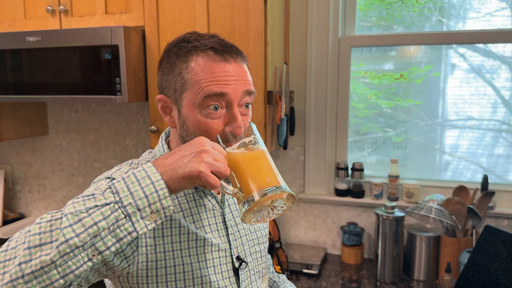
Is it just me or this guy looks like Tor Eckhoff (Apetor)?
I wonder if this would work for other viruses. I’d be interested in protection from other viruses that the mainstream scientific community deems too benign to go through the whole official process.
I don’t know what you consider the “whole official process” but it exists for good reasons.
Yeast-based vaccines seem cool, and ingestion based vaccines rather than injection increases the availability, but also counterfits. But as someone said in the article. You cannot draw conclusions from two test subjects.
Does it make pregnant women miscarry? Does it make them sterrile? How does it affect those with different blood types? how does it interact with other types of commonly taken medications? Or even food for that matter.
Don’t you think it would be good to know those things ahead of time? Because that’s what the “whole official process” is about.
I’d rather not be test subject number 3. But if others do then I’m OK with that, and over time as more people try them we can get a sense of their safety and effectiveness. Are side effects like that common with vaccines?
You need lots of test subjects, control groups, “blind tests”. And someone need to manage everything so it can be done in a controlled environment.
It’s really not as simple as just having a bunch of people testing it. You introduce placebo that way. Which the “official” process eliminates through their control groups and by injecting nothing but saline solutions while telling you it’s the real deal.
Or rather. You are made aware you may or may not recieve the real deal. You just don’t know.
Those side effects are not common. Because they would be unacceptable and “eliminated” before moving on to human trials. I put that in quotation marks because there’s probably a non zero risk. Just astronomically small.
Example. People have been observed getting drunk on non alcoholic drinks. But they’re not really drunk, they just think they are.
He must be on to something. The old moribund crowd hates the idea.
None of this is new.
Is this Photonic Induction’s twin?